
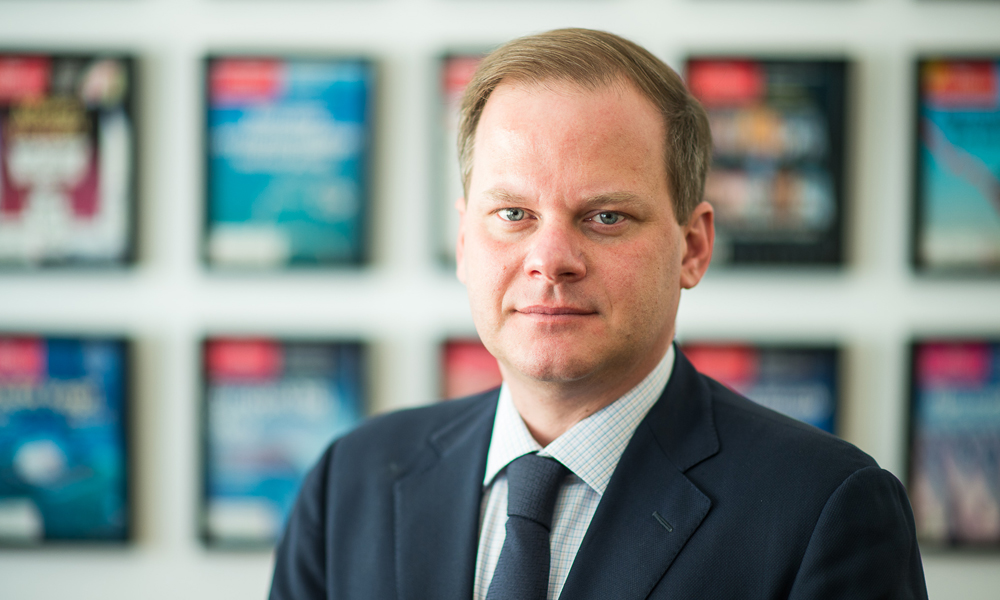
15 Nov Interview with Kostas A. Karamanlis, Minister of Infrastructure and Transport, Greece
Prisma Reports (PR): Could you tell us more about Greece’s €13-billion masterplan for infrastructure?
Kostas A. Karamanlis (KK): Our €13-billion infrastructure masterplan covers a huge spectrum of projects and has the primary intention of simply getting the economy back on track. Especially after the pandemic, it is extremely important and necessary to invest in sectors that produce tradeable goods and which have a multiplier effect on our economy. We can all agree that infrastructure projects are definitely a major part of this equation. This is why we have worked extensively to prepare a comprehensive infrastructure masterplan, part of which will also be funded by the European Recovery and Resilience Facility (RRF). We plan to reignite construction projects in infrastructure with these investments. As of today, we have already signed contracts of close to €4 billion and these projects are underway. If you compare how many public infrastructure projects have been contracted over the last four years, they amounted to less than €800 million. In two and a half years, in the middle of a global pandemic, we have managed to sign contracts for at least 10 times more than in the previous four and a half years.
To highlight a few of these projects, we can discuss first of all the subways in Athens and Thessaloniki. These two projects are designed to build sustainable mobility for everyday life. They are green projects, which also play a very important role when we talk about RRF funding. Specifically, this is the Athens metro line 4, which comprises 50 new stations. The preliminary construction sites have already begun operating in major parts of Athens and they make up part of the largest infrastructure projects to be developed in Greece in recent years, with a budget of €1.5 billion. As far as the Thessaloniki metro is concerned — a project that was derailed for a number of reasons in the past — it is moving steadily toward conclusion.
Another project that is decisively important — especially for the ministry, but also for a number of other reasons — is to complete the cross-country highway network. This is one of the biggest and one of the last great highway network projects in the European Union (EU) at this time. The E65 highway, which is the northern part, is quickly becoming a reality and it is also funded by the RRF as part of a trans-European network. It also plays a crucial role in the electrification process in that area of the country.
In rail, we are implementing an incredibly interesting €3.3-billion program. Due to our country’s geography, these kinds of rail projects have traditionally been difficult and particularly complex to pull off technically. We have already discussed this with the EU’s Directorate-General for Structural Reform Support (DG REFORM), and we are close to finalizing a system that will essentially change the way rail projects are developed in Greece. The bids are set to come out very soon and will be turnkey projects, in which we aim to avoid arrears and the overshooting of budgets, which has so often been the case historically with rail projects in this country.
We also have a comprehensive plan for large-scale anti-flood projects totaling €1.2 billion and, lastly, we are renewing our very obsolete bus fleets in Athens and Thessaloniki. This is of utmost importance and is also covered in part by the RRF. It works hand in hand with our plan of moving toward e-buses, which is critical in heavily polluted cities like Athens and Thessaloniki.
(PR): What is the scope and timeline of the Thriasio Logistics Centre project, the massive freight village to be developed to the west of Athens, and could you give us a glimpse into other opportunities currently on offer in the Greek logistics and infrastructure space?
(KK): Our main strategy is to make our country an infrastructure hub for Southeastern Europe and, to this end, we aim to attract investments in sectors such as logistics and intermodal transport. The country’s ports combined with our rail projects are poised to evolve into major freight centers. We also have to talk about the new generation of infrastructure projects that will revitalize the market and revamp our country’s image.
First of all, we are transforming Piraeus and Thessaloniki into major hubs. Thessaloniki will serve as a getaway port for Southeastern Europe and Piraeus will receive goods mostly from Southeast Asia. The Thriasio One project is back on track. This was a project that had also been derailed in the past, and we had to renegotiate the whole concession and finalize it under a very strict deadline. We have managed to achieve that and avoid any problems and penalties that might have emerged had we not finalized the project. We are also launching Thriasio Two, this time in close cooperation with the European Commission. At the same time, we are transforming our railway network with the intention of creating a sea corridor connecting the Asian markets, so that Greece can become a transport passageway to Central Europe.
Public-private partnerships (PPPs) play a key role in our government’s strategy and, out of the €13 billion in infrastructure projects that we have, almost half of them—specifically €5 billion—and the most important ones are PPPs. This is a very useful tool because it gives us access to funding, technology, human resources and to the private sector’s skills. It also creates a balance between cost and risk for the public sector, creates huge investment opportunities and they play a key role when we talk about business development. A number of companies across the spectrum of the Greek economy benefit from these projects. PPPs are hugely important for this government and are especially crucial for infrastructure projects. For a number of years, we had not tapped into this vital tool, but at this stage we are leveraging them in order to move faster and to have a more comprehensive outlook when it comes to the current agenda.
(PR): How are new investments in road and rail transportation contributing to the development of strategic corridors from the southeast Mediterranean to Central and Northern Europe?
(KK): As I said, we are implementing the largest rail program when it comes to infrastructure that has ever been planned in this country, amounting to around €3.3 billion. What comes as no surprise, especially to someone that lives here or is visiting, is that Greece has a road network that is similar to that of most developed countries in the EU. Our motorways are at par with most EU countries, mainly because 10-12 years ago the government decided to involve the private sector. Out of the five major motorways, four of them were constructed with concession agreements in which the private sector assisted through service-level agreements (SLAs).
Unfortunately, our rail network lags significantly behind. Again, this has to do with geography. Historically, rail projects have been extremely problematic from a technical standpoint and also because the procedures employed were very problematic. If we want Greece to become the logistics center of Southeastern Europe, we have to move quickly and effectively in developing electrification in our existing rail infrastructure. This is something that we are already doing, but we also need to push for greener projects, which is aligned with the very ambitious commitments the EU has for carbon-dioxide (CO2) emissions in 2030 and 2050. Of course, this is immensely important for the environment, but it is also essential for our economy and if we do not connect modern rail with ports and logistics centers, Greece can never be the regional hub to which we aspire.
One of our remaining fundamental motorway projects surrounds Egnatia and Trikala town and its connection with the PATHE motorway. It will start at the beginning of 2022 and in part is also financed by the RRF. In fact, we only have two major highway projects funded by the RRF because those types of programs do not usually fulfill the requirements.
We are also kickstarting the new generation of railway projects for the next 15-20 years, which will connect our ports with modern electrified rail, something that is imperative if we want to be a key player in the logistics sector in the region.
(PR): What are the targets and projects planned to decarbonize transport in Greek urban centers in the next decade?
(KK): One of the most important projects we already touched on briefly, and that is the Athens metro line 4. This is a new metro line in Athens, which is drastically needed, especially in a city inhabited by 5 million people in which traffic can become quite unbearable at times. This is an environmentally friendly project, which will improve our everyday life significantly. It is designed in complete accordance with sustainable development, a key factor in our planning. In both the infrastructure and transport sectors we are working methodically to prioritize projects that have a significant and positive environmental footprint. The Athens metro line 4 is a perfect example of our efforts to move toward greener, more efficient and environmentally friendly modes of transport.
Within this framework, the circular economy and sustainable development goals are top urgencies in our planning and they constitute the central core of our strategy. We are vehemently driving the shift from rural transport to railways and we have already invested in the electrification of our existing rail network, its signaling and telecommand systems. Greece had not made significant investments in these areas for a number of years. There have already been tenders launched for new projects worth approximately half a billion euros, mostly related to the modernization of the Patras, Athena, Thessaloniki, Idomeni and Promachonas axes, which are the rail connections running from Greece’s southern to northern borders.
We are also accelerating the process of implementing the European Railway Traffic Management System, the RTMS, which is very important. New bids are coming out for major projects as I mentioned, totaling €3.3 billion to connect our ports in the north in Thessaloniki, Kavala and Alexandroupoli, and to strategically connect Alexandroupoli with the ports of the Black Sea region, which allows us to bypass the Bosporus Strait.
When it comes to urban public transport and e-mobility, we are also taking very substantial steps. As we speak, we will begin the tendering process that includes 770 buses, 350 of them e-buses, 120 hybrids and 300 compressed-natural-gas (CNG) buses for Athens and Thessaloniki. This is very important, especially if you consider that Greece has not renewed its fleet for more than 12 years. If you combine the investment made in urban transport with the metro line construction projects that have already begun in Athens and the ones that are completed in Thessaloniki, our commitment both environmentally and financially to promoting sustainable public transport is apparent.
(PR): What are your ambitions as Minister of Transport and Infrastructure of Greece and where would like to see the biggest accomplishments made?
(KK): The next step in promoting e-mobility and working toward a greener transport system are e-buses and a sustainable underground system. We have already launched, together with the Ministry of Environment, a very ambitious e-mobility program and we have a very concrete strategy concerning the electrification of vehicles, which involves the renovation of our aging vehicles. We all know that transport is responsible for 30% of CO2 emissions. Our extremely ambitious goal is that one in every three cars is electric by 2030.
We have issued a number of incentives to accomplish that and, as of today, this program is moving according to plan. Around 5% of our total fleet of vehicles is now, in one way or another, hybrid or electric. There are a number of collaborations with other institutions here in Greece to have accessible infrastructure for easy charging. This year, the number of charging posts will reach around 2,000 across the country. This means that every 100 kilometers there will be a charging grid, which is hugely important, and by 2025, we will have approximately 12,000 charging posts. By 2030, our goal is to reach 25,000.
To sum up, we have a very ambitious green agenda when it comes to transport and infrastructure; we are promoting rail projects that are environmentally friendly, which is a trend that all other EU member states follow; we have a very ambitious project concerning urban transport promoting new buses and underground metro systems; and in the last two years, we have made a huge step in promoting e-mobility. All of this shows our prime minister’s commitment when it comes to transforming our country into a greener and more environmentally friendly economy.
(PR): What can you share with us about the government’s project to turn the Aegean island of Astypalaia into a green island, and how can the rest of Greece benefit from this initiative?
(KK): The whole idea is quite revolutionary but also very simple. We have chosen the small island of Astypalaia to be Europe’s first green island. Alongside private investors—including the Volkswagen group, which has shown a huge commitment in cooperating with the Greek government—the Ministry of Environment and the Ministry of Transport are all working to make Astypalaia an island in which most of its transport needs are completely electrical. As a pilot program on a small island, its success would serve as an example for other islands in Greece and in the Mediterranean to follow its lead. We are extremely excited about this groundbreaking project.
(PR): What would be your final message for our Foreign Policy readers?
(KK): Greece is back after 10 years of economic struggle and two years of a pandemic that has changed the world and our views. Greece is a country that, at this point, is dedicated to achieving its ambitious goals. As far as our ministry is concerned, these goals have to do with promoting green infrastructure and transport projects that are helping our economy revive itself. In the first semester of 2021, our economy grew around 16% and our economic growth prospects for 2021 are around 6%. In 2022, economic growth is projected to be even higher and we are, for the first time in 10 years, taking advantage of all the financial tools we have—the European structural funds, the RRF and PPPs—in order to make Greece a 21st-century country that will be leading the charge, especially in Southeastern Europe.
Sorry, the comment form is closed at this time.